
Research highlights
Featured works
Newest first, with the papers, press and releases behind them.
2026
-
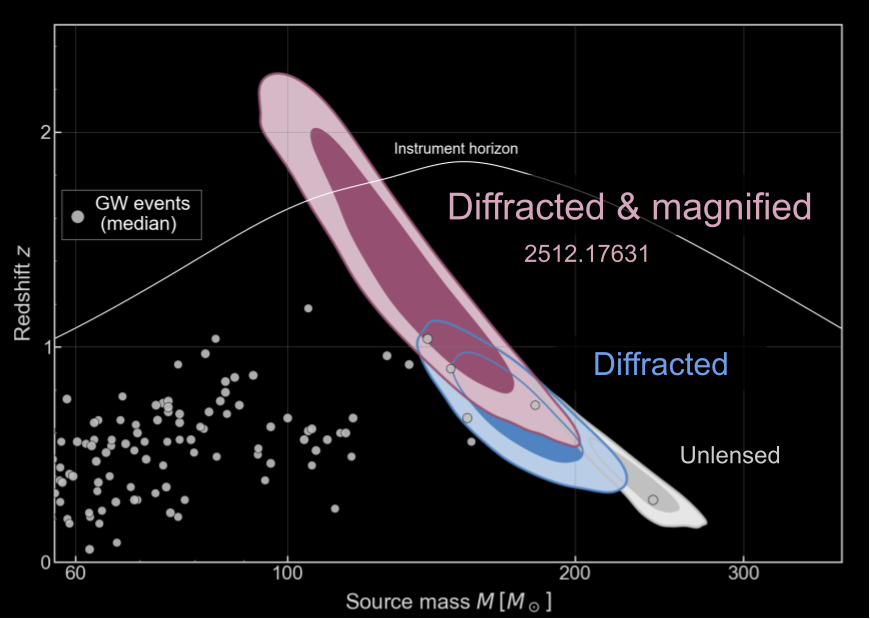 Across the Universe: GW231123 as a magnified and diffracted black hole merger
ApJL 1008, L12 (2026)
The first compelling candidate for a black-hole merger magnified and diffracted by a compact object of 190–850 M☉.
AEI press release · Max Planck press release · Science · Data release · Cosmology Talks
Across the Universe: GW231123 as a magnified and diffracted black hole merger
ApJL 1008, L12 (2026)
The first compelling candidate for a black-hole merger magnified and diffracted by a compact object of 190–850 M☉.
AEI press release · Max Planck press release · Science · Data release · Cosmology Talks
-
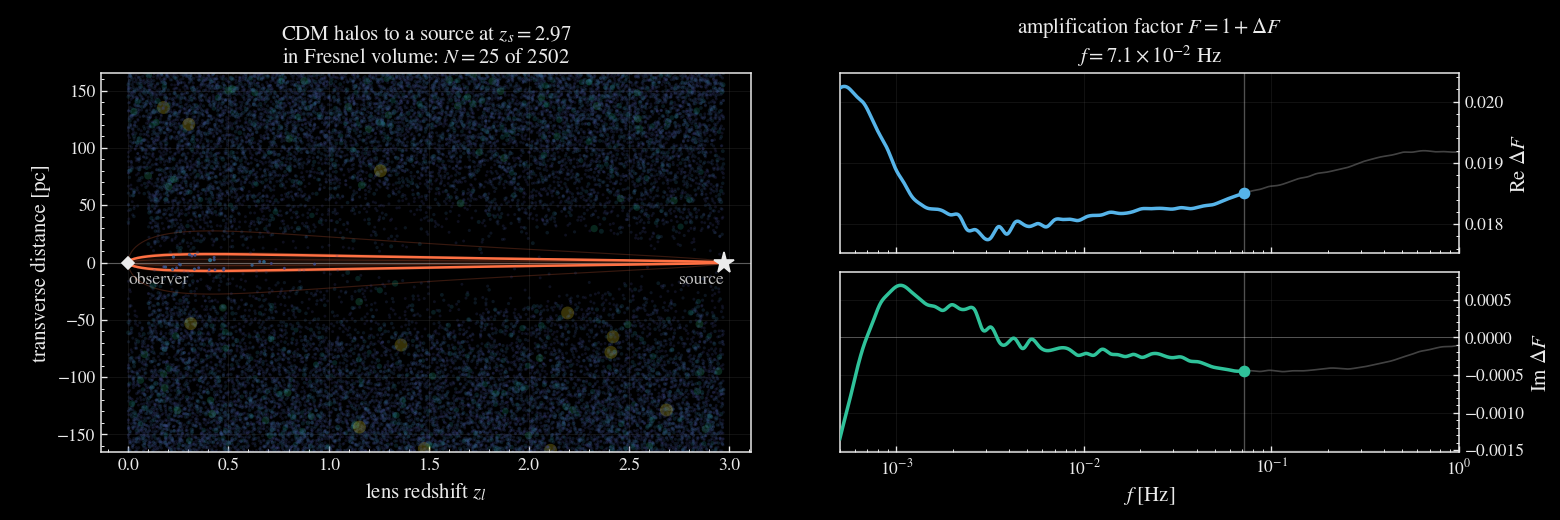 Signatures of 10–104 M☉ dark matter halos in LISA via stochastic diffraction
arXiv:2607.11887 (2026)
Populations of 10–104 M☉ dark-matter halos leave a coherent diffraction imprint, potentially within LISA's reach.
Cosmology Talks
Signatures of 10–104 M☉ dark matter halos in LISA via stochastic diffraction
arXiv:2607.11887 (2026)
Populations of 10–104 M☉ dark-matter halos leave a coherent diffraction imprint, potentially within LISA's reach.
Cosmology Talks
-
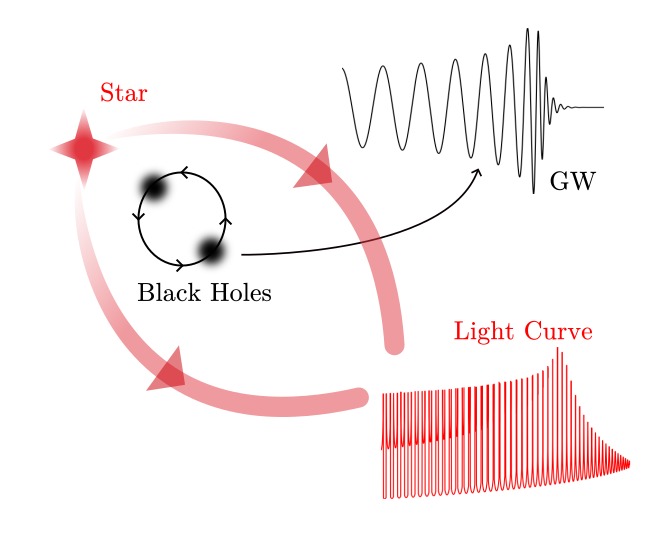 Black holes as telescopes: discovering supermassive binaries through quasi-periodic lensed starlight Editors' Suggestion
PRL 136, 061403 (2026)
Quasi-periodic lensed starlight could reveal supermassive black-hole binaries and their orbital dynamics.
AEI press release · Oxford press release
Black holes as telescopes: discovering supermassive binaries through quasi-periodic lensed starlight Editors' Suggestion
PRL 136, 061403 (2026)
Quasi-periodic lensed starlight could reveal supermassive black-hole binaries and their orbital dynamics.
AEI press release · Oxford press release
2025
-
 GLoW: novel methods for wave-optics phenomena in gravitational lensing
PRD 111, 103539 (2025)
Wave-optics amplification for general lenses, computed in milliseconds, which brings diffraction within reach of gravitational-wave parameter estimation.
The code
GLoW: novel methods for wave-optics phenomena in gravitational lensing
PRD 111, 103539 (2025)
Wave-optics amplification for general lenses, computed in milliseconds, which brings diffraction within reach of gravitational-wave parameter estimation.
The code
-
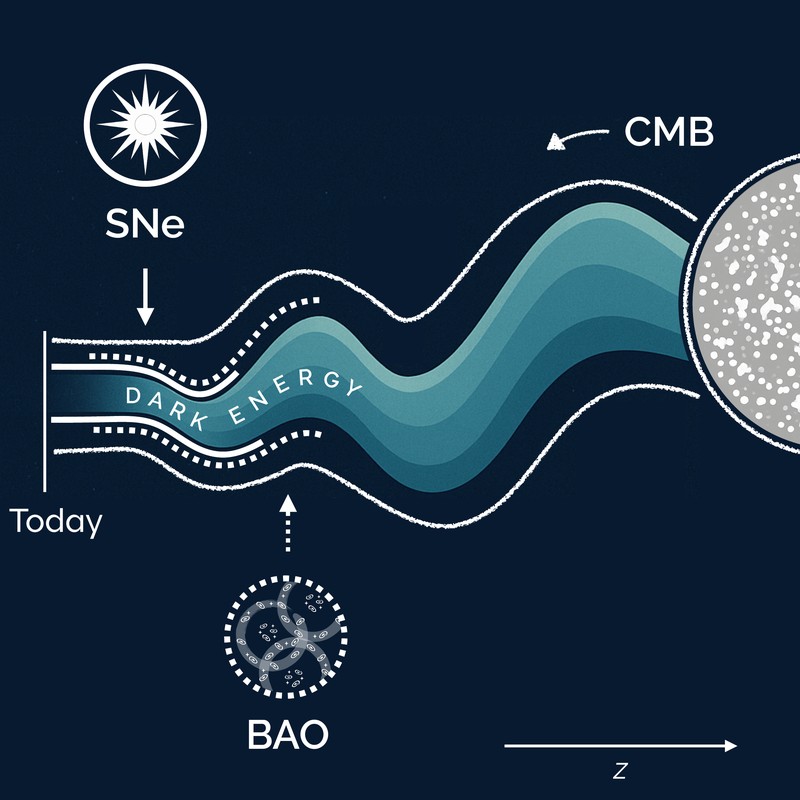 Illustration: Maria Berti
Model-independent reconstruction of the dark-energy density in light of DESI BAO data Editors' Suggestion
PRD 112, 023518 (2025)
Dark energy reconstructed straight from CMB, supernova and DESI BAO data, with no parameterization assumed, prefers evolution away from a cosmological constant at up to 2.4σ.
AEI highlight · Nova Gorica highlight · Astrobites
Illustration: Maria Berti
Model-independent reconstruction of the dark-energy density in light of DESI BAO data Editors' Suggestion
PRD 112, 023518 (2025)
Dark energy reconstructed straight from CMB, supernova and DESI BAO data, with no parameterization assumed, prefers evolution away from a cosmological constant at up to 2.4σ.
AEI highlight · Nova Gorica highlight · Astrobites
2023
- Weakly lensed gravitational waves: probing cosmic structures with wave-optics features PRD 108, 103532 (2023) Every gravitational wave is at least weakly lensed, and the resulting wave-optics features encode the number, masses, and inner profiles of the halos along the line of sight. Max Planck Yearbook 2023
- Gravitational wave lensing as a probe of halo properties and dark matter PRD 108, 103529 (2023) Diffraction and central images in a strongly lensed signal measure the mass of the lens, the slope of its density profile and the size of its core, turning lensed gravitational waves into a test of dark-matter models.
2020
-
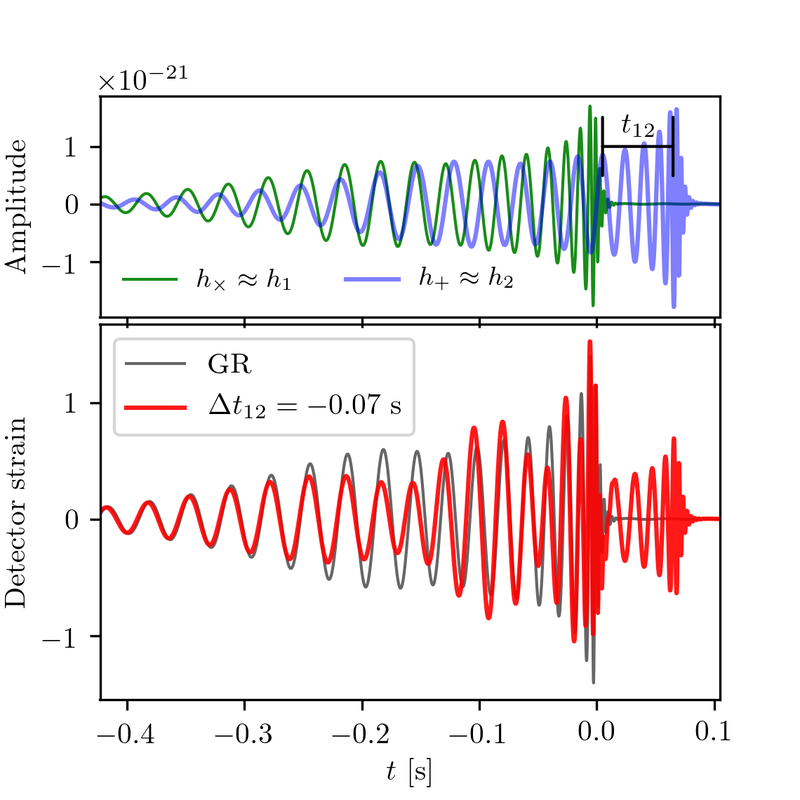 Gravitational wave lensing beyond general relativity: birefringence, echoes and shadows Editors' Suggestion
PRD 102, 124048 (2020)
In theories beyond Einstein, a lens splits a gravitational wave into eigenstates that propagate at different speeds, producing birefringence, echoes and shadows.
AEI highlight · Chicago press release · Forbes
Gravitational wave lensing beyond general relativity: birefringence, echoes and shadows Editors' Suggestion
PRD 102, 124048 (2020)
In theories beyond Einstein, a lens splits a gravitational wave into eigenstates that propagate at different speeds, producing birefringence, echoes and shadows.
AEI highlight · Chicago press release · Forbes
- Gravity in the era of equality: towards solutions to the Hubble problem without fine-tuned initial conditions PRD 102, 023523 (2020) Two mechanisms in Horndeski gravity raise the expansion rate around matter-radiation equality without fine-tuned initial conditions (unlike early dark energy), and the better of them brings the Hubble tension down from 4.4σ to 2.6σ. Cosmology from Home talk
2018
-
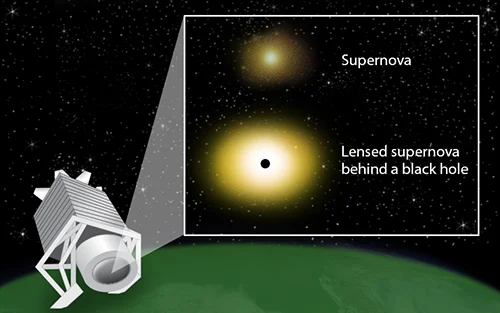 Illustration: APS/Carin Cain
Limits on stellar-mass compact objects as dark matter from gravitational lensing of type Ia supernovae Editors' Suggestion
PRL 121, 141101 (2018)
The brightnesses of distant type Ia supernovae carry no lensing skew, which limits compact objects above 0.01 M☉ to less than 35% of the matter in the Universe.
APS Viewpoint · Berkeley press release · Wired · New Scientist
Illustration: APS/Carin Cain
Limits on stellar-mass compact objects as dark matter from gravitational lensing of type Ia supernovae Editors' Suggestion
PRL 121, 141101 (2018)
The brightnesses of distant type Ia supernovae carry no lensing skew, which limits compact objects above 0.01 M☉ to less than 35% of the matter in the Universe.
APS Viewpoint · Berkeley press release · Wired · New Scientist
2017
-
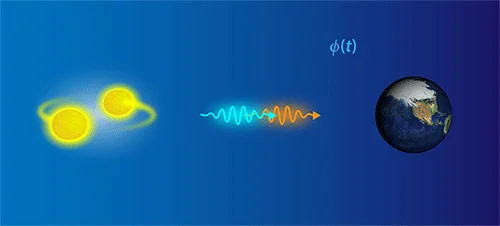 Illustration: APS/Alan Stonebraker
Dark energy after GW170817: dead ends and the road ahead Editors' Suggestion
PRL 119, 251304 (2017)
The near-simultaneous counterpart of GW170817 fixes the speed of gravitational waves to one part in 1015, leaving only three ways for a scalar-tensor theory to modify gravity today.
APS Viewpoint · Quanta Magazine · Wired
Illustration: APS/Alan Stonebraker
Dark energy after GW170817: dead ends and the road ahead Editors' Suggestion
PRL 119, 251304 (2017)
The near-simultaneous counterpart of GW170817 fixes the speed of gravitational waves to one part in 1015, leaving only three ways for a scalar-tensor theory to modify gravity today.
APS Viewpoint · Quanta Magazine · Wired
- Speed of gravitational waves and the fate of scalar–tensor gravity PRD 95, 084029 (2017) We established the necessary conditions for gravitational waves to travel at a speed different than light: the scalar field has to break Lorentz invariance spontaneously and couple to the metric through the Weyl tensor, which is what turns multi-messenger observations into a decisive test of dark energy.
2014
-
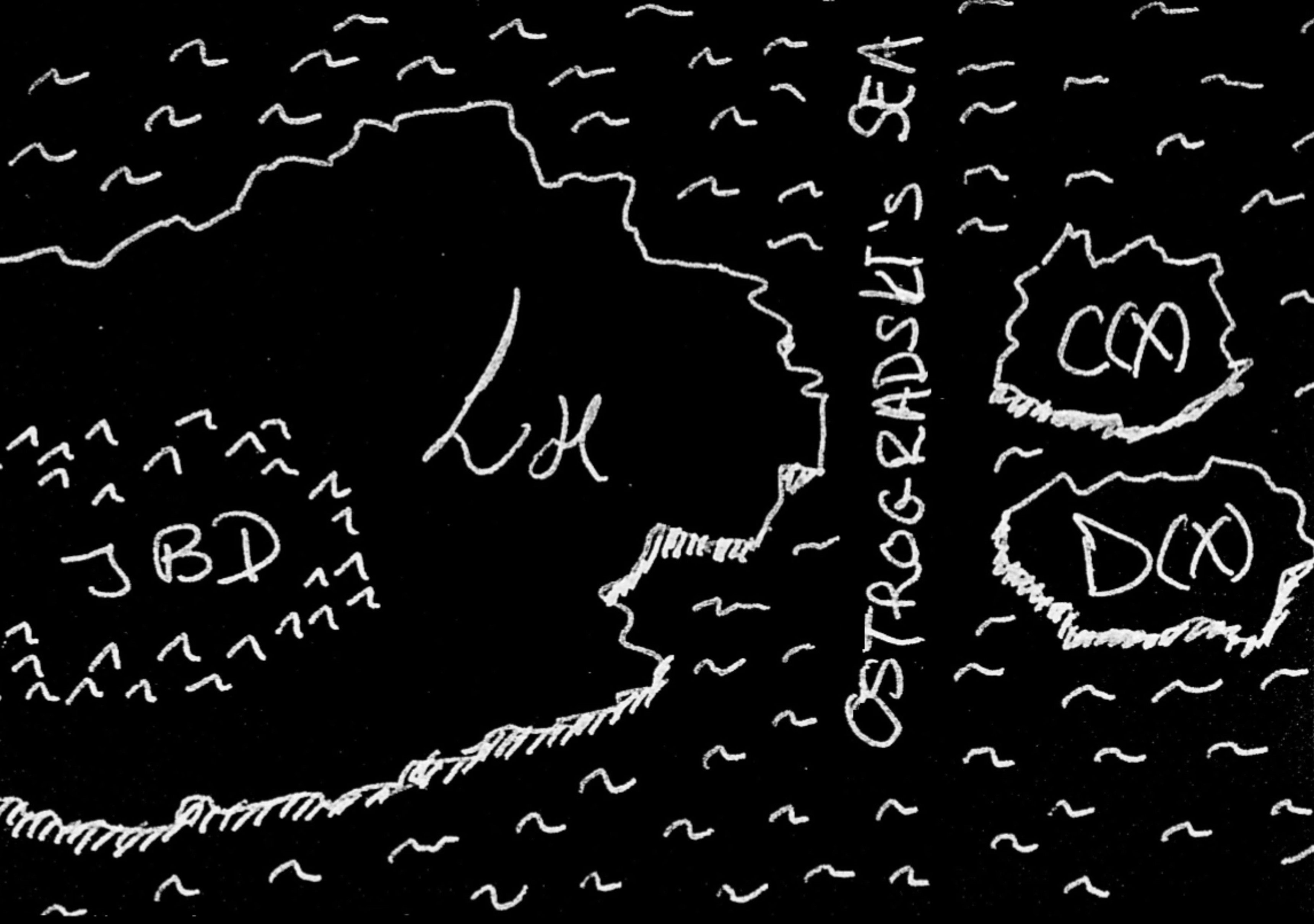 Transforming gravity: from derivative couplings to matter to second-order scalar–tensor theories beyond the Horndeski Lagrangian
PRD 89, 064046 (2014)
A derivative coupling between matter and a scalar field produces healthy theories whose equations of motion are of higher order, previously deemed fatal: the first explicit examples of scalar–tensor gravity beyond Horndeski.
Transforming gravity: from derivative couplings to matter to second-order scalar–tensor theories beyond the Horndeski Lagrangian
PRD 89, 064046 (2014)
A derivative coupling between matter and a scalar field produces healthy theories whose equations of motion are of higher order, previously deemed fatal: the first explicit examples of scalar–tensor gravity beyond Horndeski.
2012
- Screening modifications of gravity through disformally coupled fields PRL 109, 241102 (2012) A scalar field coupled to matter through its own gradients switches off its coupling in high-density regions, which keeps it invisible to solar-system tests however strong the coupling, and leaves it free to drive cosmic acceleration: the disformal screening mechanism.
This page gathers some highlighted publications. See the full record on INSPIRE-HEP.