
For the public and the press
Outreach
Public lectures, popular-science writing and press coverage, in English, Spanish and German.
Press and media
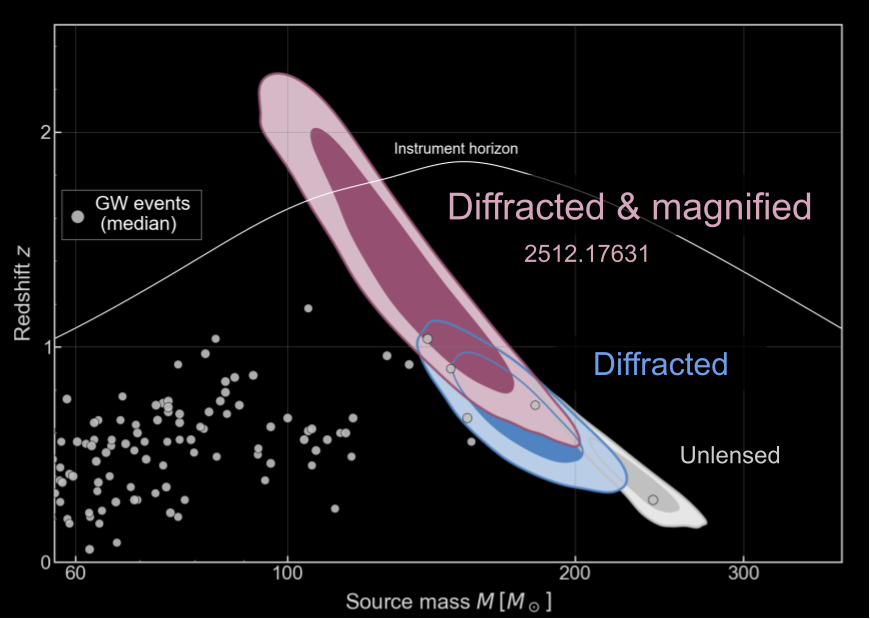
A magnified and diffracted black-hole merger (2026)
Our analysis of GW231123, which we argue is the first compelling candidate for a black-hole merger magnified and diffracted by a compact object, was published in The Astrophysical Journal Letters, with press releases from the Albert Einstein Institute and the Max Planck Society asking whether black holes pretend to have large masses. It was covered by Science, Phys.org and SKYCR, in German by bild der wissenschaft and scinexx, in Spanish by National Geographic and Xataka, in French by Ciel & Espace and Trust My Science, in Italian by Tom’s Hardware, and in Portuguese, Polish and Serbian. I also discussed the result on Cosmology Talks.
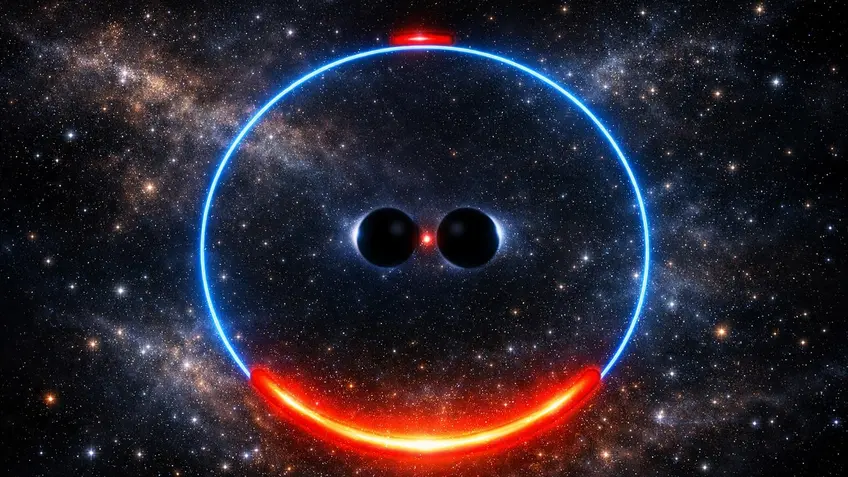
Black holes as telescopes (2026)
Our work on discovering supermassive black-hole binaries through quasi-periodic lensed starlight was an Editors' Suggestion in Physical Review Letters, with press releases from the Albert Einstein Institute and the University of Oxford. It was covered by Phys.org, myScience, ScienMag and the LISA Newsletter.
ERC Consolidator Grant (2025)
The GLOW award was announced by the Albert Einstein Institute and the Max Planck Society. In the same year I acted as expert advisor for the Kurzgesagt video Cosmic Crisis (sources), and was interviewed by El País for ¿Podremos viajar en el tiempo?
Wave-optics lensing and dark energy (2023–2025)
My work on wave-optics lensing appeared in the Max Planck Society 2023 Yearbook. The project With Einstein on Crooked Paths was funded by Max Planck supporting members as the 2024 Annual Project. Our model-independent reconstruction of dark-energy evolution was an Editors' Suggestion in Physical Review D, highlighted by the AEI and the University of Nova Gorica. Astrobites wrote up both that reconstruction and our analysis of anomalous lensing effects in LIGO–Virgo–KAGRA data, and the AEI highlighted our work on strong-field effects on gravitational-wave propagation.
Gravitational-wave lensing beyond Einstein's theory (2020)
Our work showed that a lens breaks the symmetry of the cosmological background, so that in theories beyond Einstein a lensed wave acquires birefringence, echoes and shadows, signatures that a smooth background cannot produce. The paper was an Editors' Suggestion in Physical Review D, with a press release from the University of Chicago and a research highlight from the Albert Einstein Institute. It was covered by Forbes, The Debrief and Europa Press.
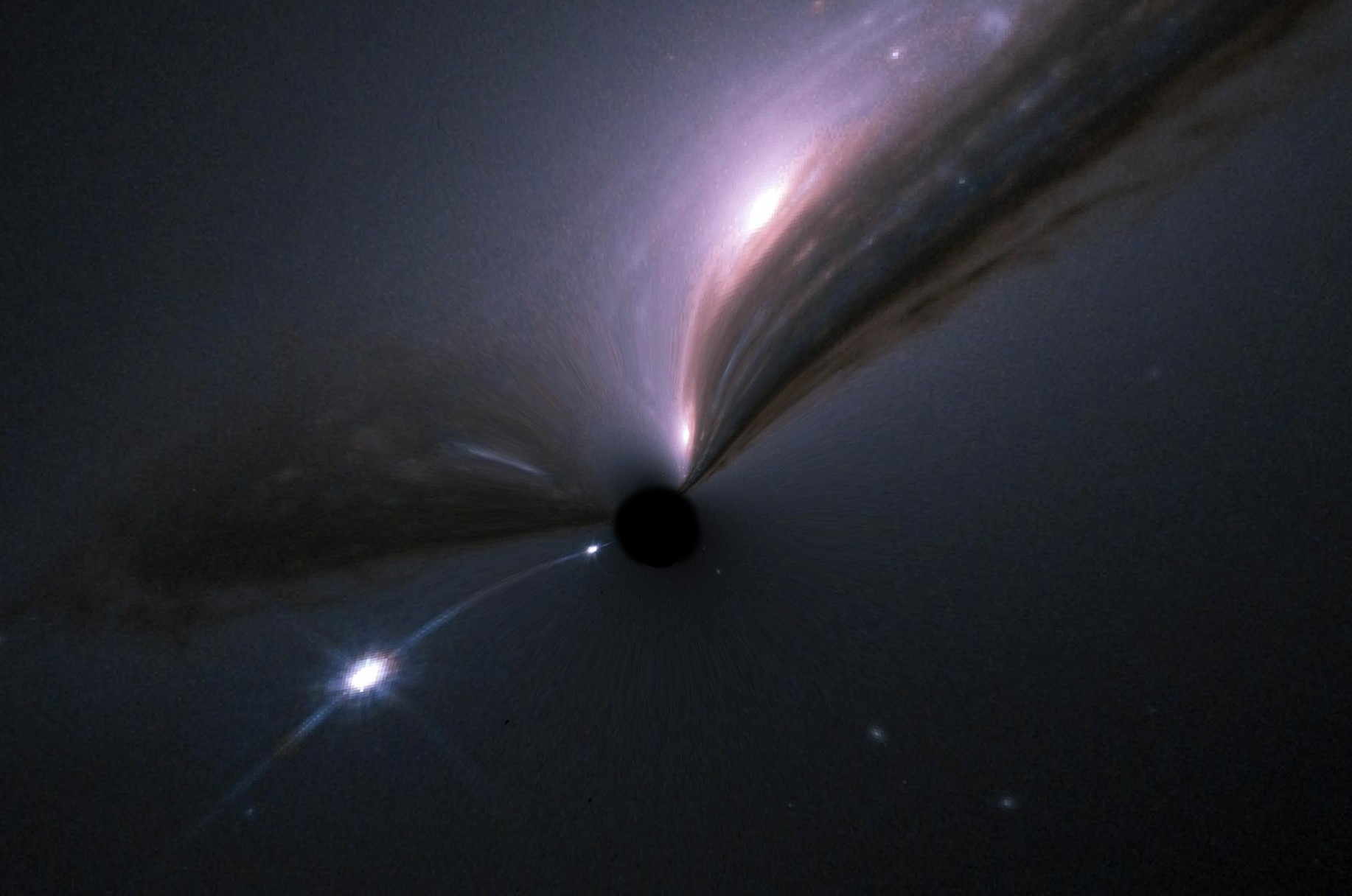
Primordial black holes and dark matter (2018)
Our limit on compact objects as dark matter, from the gravitational lensing of type Ia supernovae, was an Editors' Suggestion in Physical Review Letters with an APS Viewpoint and a press release from UC Berkeley. It was covered by Wired, New Scientist, The Daily Californian, Forbes and CEA (in French). The paper's title also inspired an interview in El Confidencial and a video (both in Spanish).
Dark energy after GW170817 (2017)
Our analysis of GW170817 showed that its near-simultaneous electromagnetic counterpart fixes the speed of gravitational waves to one part in 1015, which ruled out large classes of dark-energy theories in a single stroke. The paper was an Editors' Suggestion in Physical Review Letters with an APS Viewpoint and a press release from Berkeley Lab. It was covered by Quanta Magazine, Wired, Science News, New Scientist, Forbes and PNAS Inner Workings.
Also: a community profile in the EuCAPT blog (2022), and a feature among the best Swedish space-science research of 2015 (in Swedish).
Explanatory video
A short introduction to gravitational-wave lensing, for a general audience.
Popular-science articles
In print
- Las teorías de la gravedad tras la tormenta cósmica Investigación y Ciencia (Spanish edition of Scientific American), 2018. In Spanish.
- Articles in the Berkeley Science Review Including “From the Field”, Spring 2018 issue.
- Mathematical & Physical Sciences Newsletter College of Letters & Science, UC Berkeley, 2018. Two articles.
Online
- Ondas gravitacionales y energía oscura: el fin de una era La Física del Grel, 2018. In Spanish.
- Gravitational waves from neutron stars and the 2017 Nobel Prize Sparrho Blog, 2017.
- Las ondas gravitacionales: siguiendo el rumor más tenue hacia los secretos del cosmos FronteraD, 2016. In Spanish.
- GW150914, la persistencia y el genio FronteraD, 2016. In Spanish.
- Pequeño mapa del mundo en potencias de diez (I): contando cifras FronteraD, 2015. In Spanish.
- El valor de la ficción and Persistencia y serendipia FronteraD, 2015. In Spanish.
- Los neutrinos y el límite de velocidad de Einstein FronteraD and El Faro, 2011. In Spanish.
- ¿Por qué ha tenido tanta repercusión el descubrimiento de las ondas gravitacionales? Chapter in Ciencia, y además lo entiendo. In Spanish.
Public lectures
- Los senderos tortuosos en la teoría de Einstein (Benasque Science Center, 2026) In Spanish. Event page
- Sounds of Silence: 10 years of gravitational-wave astronomy (Long Night of Astronomy, 2025) Event page
- Mit Einstein auf krummen Wegen (Potsdamer Tag der Wissenschaften, 2025) In German. Event page
- Deciphering Black Hole Symphonies (Berlin Science Week, 2024) Event page
- Mit Einstein auf krummen Wegen (presentation of the philanthropically supported project to Max Planck donors, 2024) In German.
- Gravitational Waves: Messengers from the Dark Universe (Astro Night, UC Berkeley, 2019) Astro Night
- Gravitational Waves: Messengers from the Dark Universe (Cal Day 2018, on the 150th anniversary of the University of California)
- Crossing the Event Horizon: Mysteries of Gravity (Taste of Science Festival, Berkeley, 2018) Event page
- Primordial black holes as a dark-matter candidate (Astrophysics Roundtable, UC Berkeley, 2018)
Archive by language
Wissenschaftskommunikation (Deutsch)
Meine Arbeit wurde in verschiedenen Medien vorgestellt, darunter:
- Pressemitteilungen des AEI: Täuschen Schwarze Löcher große Massen vor? (2026), Neue Methode könnte versteckte Paare extrem massereicher Schwarzer Löcher entdecken (2026) und ERC Consolidator Grant für Miguel Zumalacárregui (2025).
- Berichte über GW231123: Rätsel um „übergewichtige“ Schwarze Löcher gelöst? (bild der wissenschaft, 2026) und Ist das Geheimnis übergewichtiger Schwarzer Löcher gelüftet? (scinexx, 2026).
- Vorträge Mit Einstein auf krummen Wegen beim Potsdamer Tag der Wissenschaften (2025) und beim Spendeprojekt (2024).
- Mit Einstein auf krummen Wegen — Spendenprojekt 2024, Max-Planck-Gesellschaft (Pressemitteilung).
- Ein Blick auf Gravitationswellen durch Einsteins Lupe — Forschungsbericht 2023, Max-Planck-Gesellschaft.
Divulgación científica (español)
Colaboro habitualmente con medios en español. Además de los artículos listados arriba, mi trabajo ha aparecido en El Confidencial, El País, Naukas y Rexmolon. Escribo ocasionalmente en el blog Persistencia y serendipia y respondo preguntas en FdeT.
Radio y podcasts
- Segmento Astronómico — entrevista sobre lentes gravitacionales de supernovas, agujeros negros primordiales y materia oscura (2018).
- Horizonte de Sucesos — varias entrevistas sobre ondas gravitacionales, energía oscura y la anomalía gravitacional axial (2017–2018).
- Coffee Break: Señal y Ruido (2017–2018) — ondas gravitacionales y energía oscura (Ep. 134, min. 47) y agujeros negros primordiales (Ep. 143, min. 72).
- Rewisor — entrevista sobre GW170817 (2017).
English
Most of the material on this page is in English. See public lectures, popular-science articles and press coverage above.