
Theory, phenomenology & data interpretation
Research
My research runs in parallel strands: wave-optics lensing of gravitational waves, dark matter, strong-field and multi-messenger lensing, and tests of gravity. All of them rest on a foundation of cosmology, dark energy and gravitational theory. Each strand is described below, with the papers that carry it.
My research encompasses four key predictions of Einstein's theory of general relativity: cosmology (the dynamics and history of the Universe), gravitational waves (ripples in spacetime itself), black holes (regions where gravity is strong enough to trap light) and gravitational lensing (the distortion of signals traveling through the Universe). I use these phenomena to explore astrophysics, dark matter, dark energy and gravity, including general relativity itself: the theory that contains all four.
Selected work appears below. The research highlights gather the results with the press coverage and data releases behind them, and the complete and current record is on:
Wave-optics lensing phenomena
A gravitational wave that passes near a mass is not simply magnified. When the lens is such that its gravitational radius is comparable to the wavelength, the wave diffracts and interferes with itself: the resulting frequency-dependent pattern encodes the mass, the profile and even the substructure of the lens. The same is true of any phase-coherent signal. That makes lensing a probe of objects that emit no light at all. Because a lens breaks the symmetry of the background, it is also a test of gravity itself. This strand is funded by the GLOW ERC Consolidator Grant.
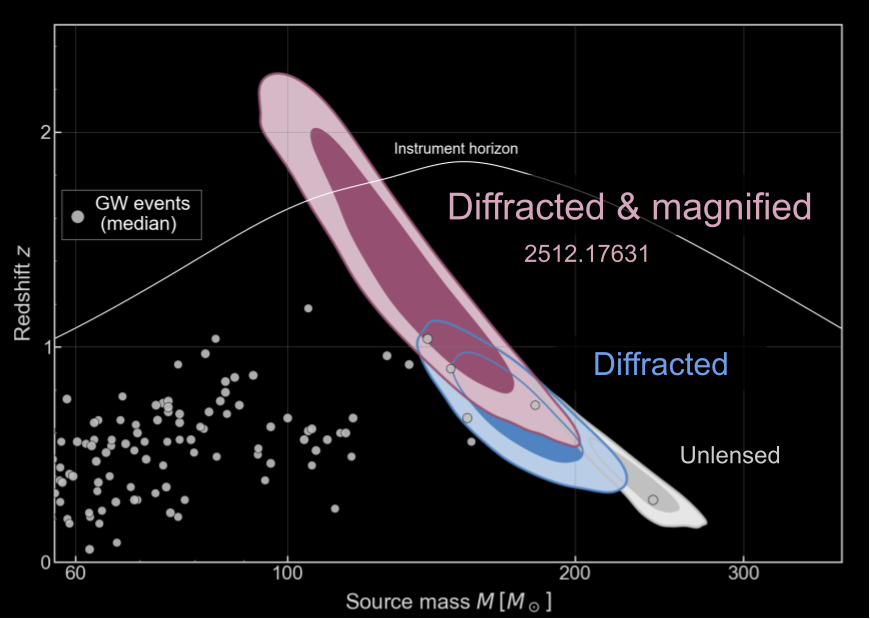
Geometric optics (the picture of light rays bending around a mass) breaks down when the wavelength becomes comparable to the Schwarzschild radius of the lens. For gravitational waves that happens for lens masses below ~104 M☉ in the LIGO band, and far higher masses for LISA. In this wave-optics regime the amplification factor becomes frequency dependent, producing a characteristic modulation across the signal rather than a simple overall magnification.
That frequency dependence is what makes the effect useful. A lensed event constrains the lens mass distribution because different profiles diffract differently, analogous to diffraction patterns observed in crystallography. It also breaks the magnification–distance degeneracy that plagues lensing in the geometric limit: the modulation is set by the redshifted lens mass, so a diffracted signal carries an absolute mass scale rather than only a relative magnification. The presence of a diffracting object further breaks degeneracies with the external potential, helping constrain the gravitational magnification.
We derived efficient methods for computing these amplification factors, validated them against symmetric lenses where analytic results exist, and extended them to general matter distributions. The resulting machinery is public as the GLoW code. It allowed us to analyze GW231123, which we argue is the first compelling candidate for a magnified and diffracted black-hole merger.
Selected publications
- Across the Universe: GW231123 as a magnified and diffracted black hole merger Astrophys. J. Lett. 1008, L12 (2026) Featured by the Albert Einstein Institute
- Lensing of gravitational waves: efficient wave-optics methods and validation with symmetric lenses Phys. Rev. D 108, 043527 (2023)
- Weakly lensed gravitational waves: probing cosmic structures with wave-optics features Phys. Rev. D 108, 103532 (2023) Featured by Max Planck Society Yearbook 2023
- A magnified and diffracted black-hole merger (GW231123), talk on Cosmology Talks (2026)
- Lensing of GWs: new opportunities for fundamental physics, talk at Cosmology from Home (2024)
- Introductory video on gravitational-wave lensing, for a general audience
Dark matter and small-scale structure
Cold dark matter and its alternatives (warm, fuzzy, self-interacting, primordial black holes) agree on large scales and disagree below galactic scales. That is precisely where the observational evidence is thinnest, because sub-galactic halos contain few or no stars. Because lensing responds to mass instead of light, it provides means to probe these elusive halos.
Two complementary handles come out of this. In some cases, diffraction by a single object may be used to constrain the properties of an individual halo. But even when no single lens dominates, the accumulated effect of many small structures along the line of sight leaves a characteristic imprint on the signal: lens stochastic diffraction, which resembles a noise term but has a specific spectral shape and correlations with the underlying signal. For LISA, that imprint would be sensitive to halos of 10–104 M☉, a range that is hard to reach by other means.
The electromagnetic side of the same argument gave one of the sharpest existing limits on compact dark matter: if a large fraction of dark matter were in stellar-mass black holes, the brightnesses of distant type Ia supernovae would be visibly skewed: most slightly dimmed, a few substantially brighter. The observed distribution shows no such skew, which rules out LIGO-mass black holes as the bulk of dark matter.
Selected publications
- Signatures of 10–104 M☉ dark matter halos in LISA via stochastic diffraction arXiv:2607.11887
- Limits on stellar-mass compact objects as dark matter from gravitational lensing of type Ia supernovae Phys. Rev. Lett. 121, 141101 (2018) Editors' Suggestion APS Viewpoint Featured by UC Berkeley, CEA, New Scientist
- Gravitational wave lensing as a probe of halo properties and dark matter Phys. Rev. D 108, 103529 (2023)
See also Lens stochastic diffraction: a signature of compact objects in gravitational-wave data.
- Probing low-mass dark matter halos with LISA, talk on Cosmology Talks (2026, with Choi & Urrutia)
- Primordial black-hole constraints from supernova lensing, talk at a CERN workshop (2018)
Strong-field and multi-messenger lensing
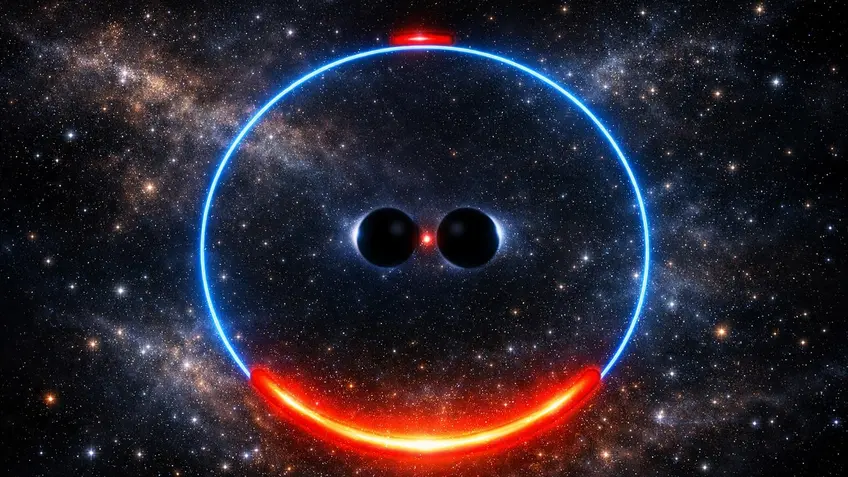
Black hole binaries are usually studied as sources, but they are also excellent lenses. When a star lies behind a supermassive binary, the orbital rotation of the system produces a quasi-periodic magnification with a distinctive shape. This phenomenon can open a new window into the population of sub-parsec binary systems: the same systems that will dominate the LISA and pulsar-timing signal, and that are otherwise very hard to resolve. Closer to home, we found that continuous gravitational waves from sources behind Sgr A* can be detected well beyond the Einstein radius, and resolved as separate images.
Strong fields also change how the wave itself propagates. Near a massive body the standard lensing formalism (weak fields, small deflections, a single flat background) no longer holds: at first order beyond geometric optics the wave's polarization couples to the background curvature, and the two polarizations follow slightly different trajectories. This gravitational spin-Hall effect makes the arrival time depend on both frequency and polarization.
Multi-messenger lensing is the wider frontier. A lensed gravitational wave and a lensed electromagnetic counterpart of the same event constrain the lens far better than either alone, because they probe complementary regimes: gravitational waves are diffracted by stars, but light is described by geometric-optics lensing. Building this into a coherent observational strategy across gravitational interferometers and time-domain electromagnetic surveys is a community-scale effort where wave-optics phenomena may be crucial for discovery.
Lensed electromagnetic sources probe the lens distribution in their own right, and that knowledge feeds back into the gravitational-wave side. Surveys such as Euclid are expected to deliver on the order of a hundred thousand galaxy–galaxy strong lenses, transforming empirical knowledge of the lens population: calibrating the priors that lensed-GW searches rely on, and letting multiply-imaged candidates be cross-matched against lens catalogs, an association that sharpens the localization and opens cosmography applications.
Selected publications
- Black holes as telescopes: discovering supermassive binaries through quasi-periodic lensed starlight Phys. Rev. Lett. 136, 061403 (2026) Editors' Suggestion Featured by AEI, University of Oxford, Phys.org
- From the gates of the abyss: frequency- and polarization-dependent lensing of gravitational waves in strong gravitational fields Phys. Rev. D 109, 124045 (2024) Featured by AEI
- Multi-messenger gravitational lensing Phil. Trans. R. Soc. A 383, 20240134 (2025)
Gravitational-wave propagation and dark energy
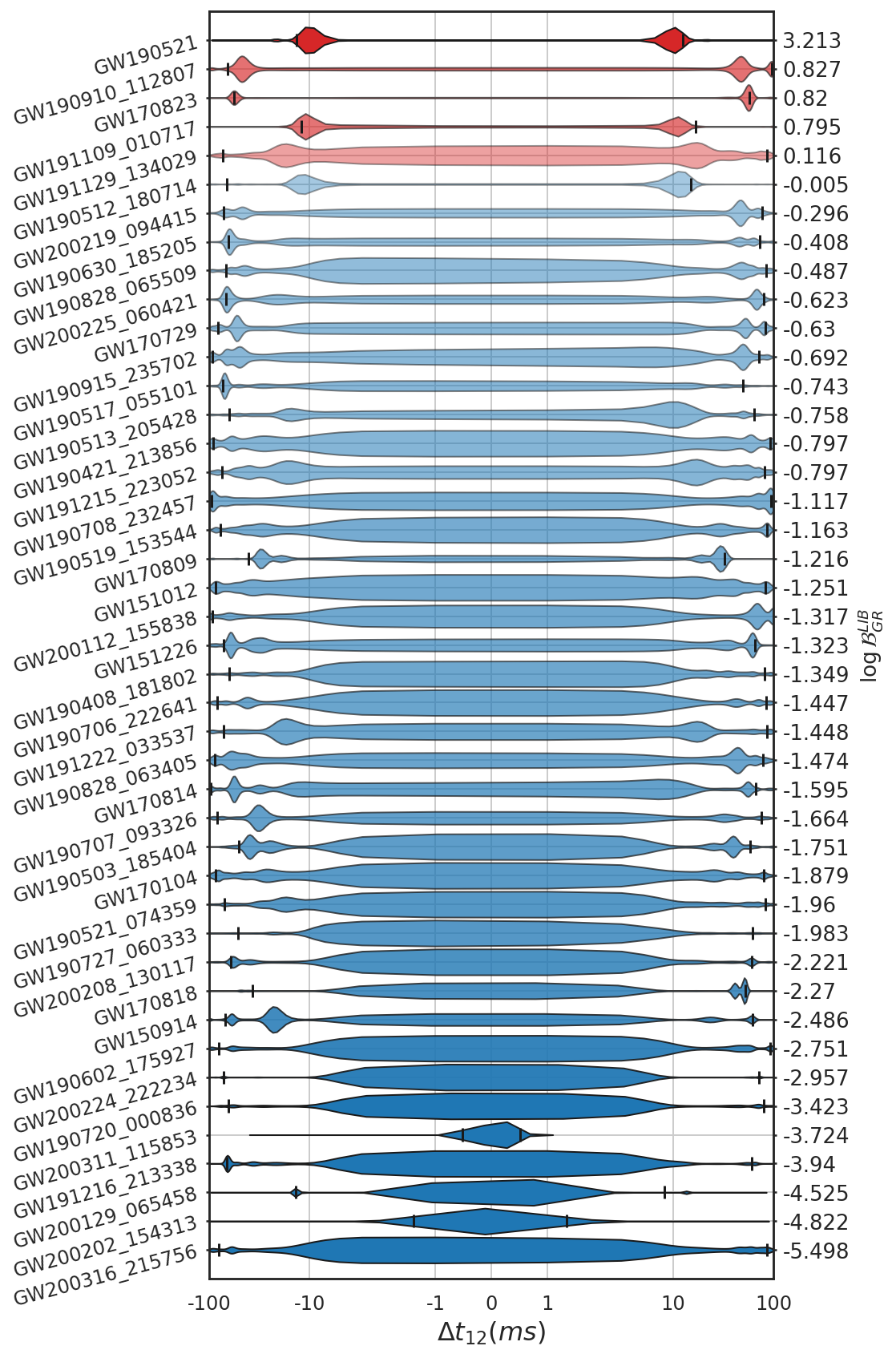
Any deviation from Einstein's theory builds up along a gravitational wave's journey, making propagation a clean test of cosmological gravity. My earlier work identified the speed of gravitational waves as a sharp test for many classes of modified theories. GW170817 settled the question: its near-simultaneous electromagnetic counterpart fixed that speed to one part in 1015, which removed large classes of dark-energy theories in a single stroke.
Lensing sharpens and broadens the test, because a lens does what a smooth cosmological background cannot: it breaks the symmetry. In modified theories, this allows the wave to mix with new fields of different spin through couplings that vanish on a homogeneous, isotropic background. The result is birefringence, with the two polarizations propagating differently as if the lens were an anisotropic crystal, and dispersion, with the frequency components spreading like light forming a rainbow. These tests rely on distortions of the waveform, requiring no electromagnetic counterpart and allowing for searches over entire source catalogs.
The program extends this from the high-frequency expansion to a complete wave-optics formalism, and from specific dark-energy models to a theory-agnostic parameterization of lensing beyond Einstein (the analog of the post-Newtonian parameters in the Solar System), delivered as a likelihood module for cosmological analyses.
Selected publications
- Dark energy after GW170817: dead ends and the road ahead Phys. Rev. Lett. 119, 251304 (2017) Editors' Suggestion APS Viewpoint Featured by Berkeley Lab
- Gravitational wave lensing beyond general relativity: birefringence, echoes and shadows Phys. Rev. D 102, 124048 (2020) Editors' Suggestion Featured by AEI, University of Chicago
- Gravitational-wave dispersion over inhomogeneous space-times: general relativity, screened theories of gravity and non-minimal dark energy JCAP, accepted · arXiv:2511.08023
See also the geometric-optics expansion and lens-induced dispersion, the review Dark energy in light of multi-messenger gravitational-wave astronomy, and Testing modified gravity at cosmological distances with LISA standard sirens.
- Tests of gravitational-wave propagation, talk at Dark Energy from Home (2026)
- GW lensing beyond general relativity, talk in the SISSA gravity webinars
- Gravitational waves à la general relativity, or scrambled?, Astrobites
Methods, inference and public software
Wave-optics lensing is computationally challenging: the amplification factor stems from an oscillatory integral, and a naive evaluation is far too slow to sit inside a parameter-estimation loop. A large part of my work is therefore methodological: finding formulations that are both accurate and fast enough for systematic exploration and Bayesian inference.
The results are public. GLoW implements contour-integration and time-domain methods for general matter distributions (see also Glworia, WOlensing and Microlensing_Wave_Effect). These software tools facilitate the reproducibility of scientific results and the exploration of new ideas.
Speed is not only a convenience. We have adapted machine learning methods to facilitate systematic lensing searches over entire source catalogs: a network trained on microlensed waveforms can perform analyses in minutes rather than days.
Selected publications
- GLoW: novel methods for wave-optics phenomena in gravitational lensing Phys. Rev. D 111, 103539 (2025)
- Accelerated inference of microlensed gravitational waves with machine learning Phys. Rev. D 113, 104073 (2026)
- Effective description of lensed gravitational waves diffracted by stellar fields arXiv:2606.17765
Cosmology and gravity theories
Cosmological tests of dark energy, and the scalar–tensor theories behind them. This line preceded the lensing work and continues alongside it, through collaborations, the hi_class code and its own funding. It is also where much of the theoretical machinery the lensing work relies on came from.
Cosmological tests of gravity and dark energy
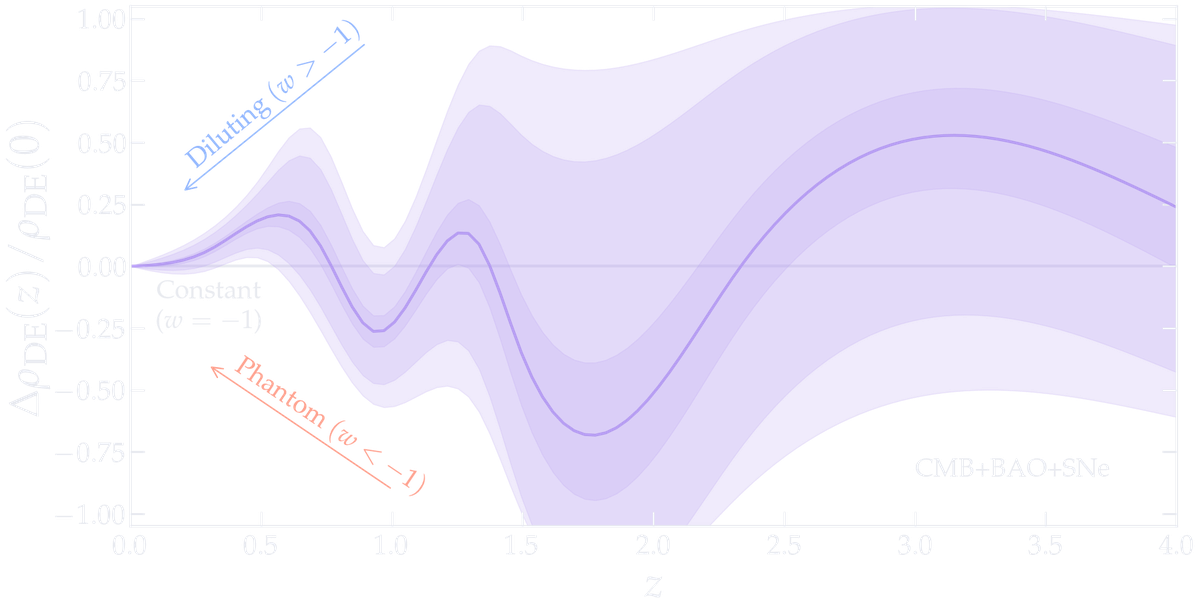
Testing the physics behind cosmic acceleration against data, considering mechanisms beyond a simple cosmological constant. Recent work re-examined DESI's evidence for dynamical dark energy by reconstructing the dark-energy density directly from the data, without committing to a parameterization.
Another key goal is what surveys can actually deliver: what forthcoming data will say about scalar–tensor theories, and the individual signatures: cosmic shear, the non-linear shift of the BAO ruler, relativistic effects at ultra-large scales, and obtaining relativistic predictions from standard Newtonian simulations.
- Reconstructing the dark energy density in light of DESI BAO observations Phys. Rev. D 112, 023518 (2025) Editors' Suggestion Featured by AEI
- Observational future of cosmological scalar–tensor theories Phys. Rev. D 95, 063502 (2017)
- Fully relativistic predictions in Horndeski gravity from standard Newtonian N-body simulations JCAP 09, 024 (2021)
- Testing (modified) gravity with 3D and tomographic cosmic shear Mon. Not. Roy. Astron. Soc. 480, 3725 (2018)
- Nonlinear evolution of the baryon acoustic oscillation scale in alternative theories of gravity Phys. Rev. D 92, 063522 (2015)
- Gravity at the horizon: on relativistic effects, CMB–LSS correlations and ultra-large scales in Horndeski's theory JCAP 07, 040 (2016)
Model building and cosmic tensions
Phenomenological parameterizations are useful to test data, but do not map back to fundamental theories. It is therefore essential to build theories from first principles: theories that can be confronted with every dataset at once, and that still have to survive tests from the solar system to the cosmological horizon. A crucial aspect is that the parameters of full theories jointly determine all the predictions: background expansion and large-scale structure are no longer separate levers that can be pulled independently.
The Hubble tension is the sharpest case: the covariant Galileon relieves it through several distinct mechanisms within one theory, and is able to shift H0 without fine-tuned initial conditions. Beyond individual models, theoretical priors chart which regions of Horndeski space survive before any data are involved, and massive gravity raises the prior question of whether cosmic expansion can be accommodated at all.
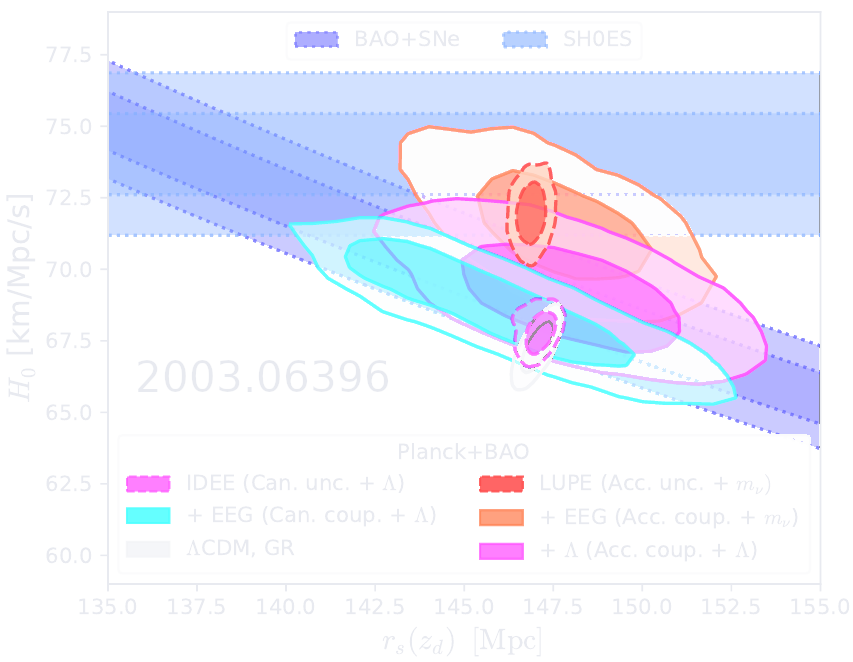
- Gravity in the era of equality: towards solutions to the Hubble problem without fine-tuned initial conditions Phys. Rev. D 102, 023523 (2020)
- Galileon gravity in light of ISW, CMB, BAO and H0 data JCAP 10, 020 (2017)
- Theoretical priors in scalar–tensor cosmologies: shift-symmetric Horndeski models Phys. Rev. D 104, 083502 (2021)
- To the problem of cosmic expansion in massive gravity JCAP 08, 026 (2025)
hi_class
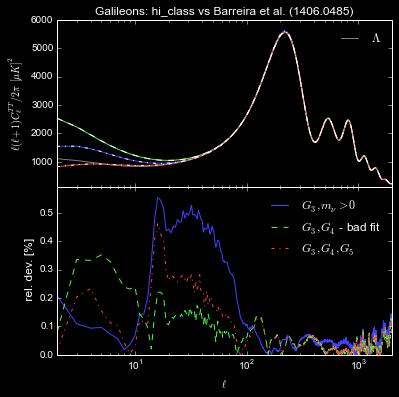
An Einstein–Boltzmann solver covering the full Horndeski class. It is fast and stable enough for Bayesian inference; flexible and general enough to span quintessence, Horndeski and theories beyond it, specified either by a Lagrangian or by the effective functions that govern linear perturbations; and accurate at the sub-percent level, meeting the requirements of current surveys and checked against independent implementations.
- hi_class: Horndeski in the Cosmic Linear Anisotropy Solving System JCAP 08, 019 (2017)
- hi_class: background evolution, initial conditions and approximation schemes JCAP 02, 008 (2020)
- Comparison of Einstein–Boltzmann solvers for testing general relativity Phys. Rev. D 97, 023520 (2018)
Scalar–tensor gravity beyond Horndeski
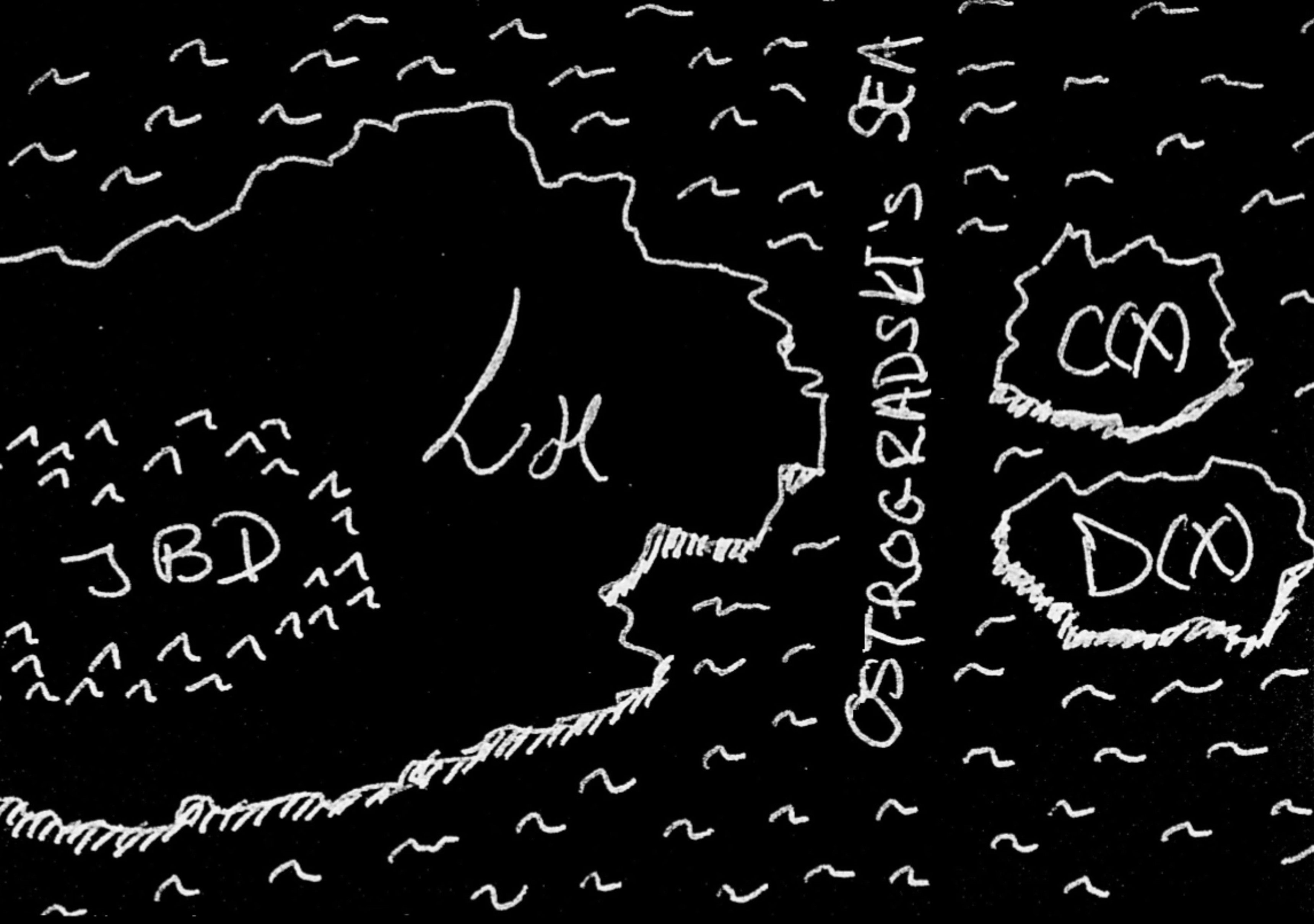
Horndeski's theory is the most general scalar–tensor Lagrangian with second-order equations of motion, which was long taken to be an unavoidable condition to avoid the ghosts that plague higher-derivative theories. It is not: equations of higher order can still be degenerate, and so free of ghosts. Generalized field redefinitions of the metric are how the first explicit examples beyond Horndeski were built.
- Transforming gravity: from derivative couplings to matter to second-order scalar–tensor theories beyond the Horndeski Lagrangian Phys. Rev. D 89, 064046 (2014)
- Towards the most general scalar–tensor theories of gravity: a unified approach in the language of differential forms Phys. Rev. D 94, 024005 (2016)
- Shaken, not stirred: kinetic mixing in scalar–tensor theories of gravity Phys. Rev. D 91, 104009 (2015)
Disformal transformations
Adding to the metric a term built from derivatives of a scalar field generalizes the conformal rescaling that relates the Einstein and Jordan frames. The consequences are concrete: a disformally coupled scalar becomes a DBI Galileon once written in the Einstein frame, and the same coupling screens fifth forces in dense environments, hiding the scalar where laboratory tests would otherwise have found it.
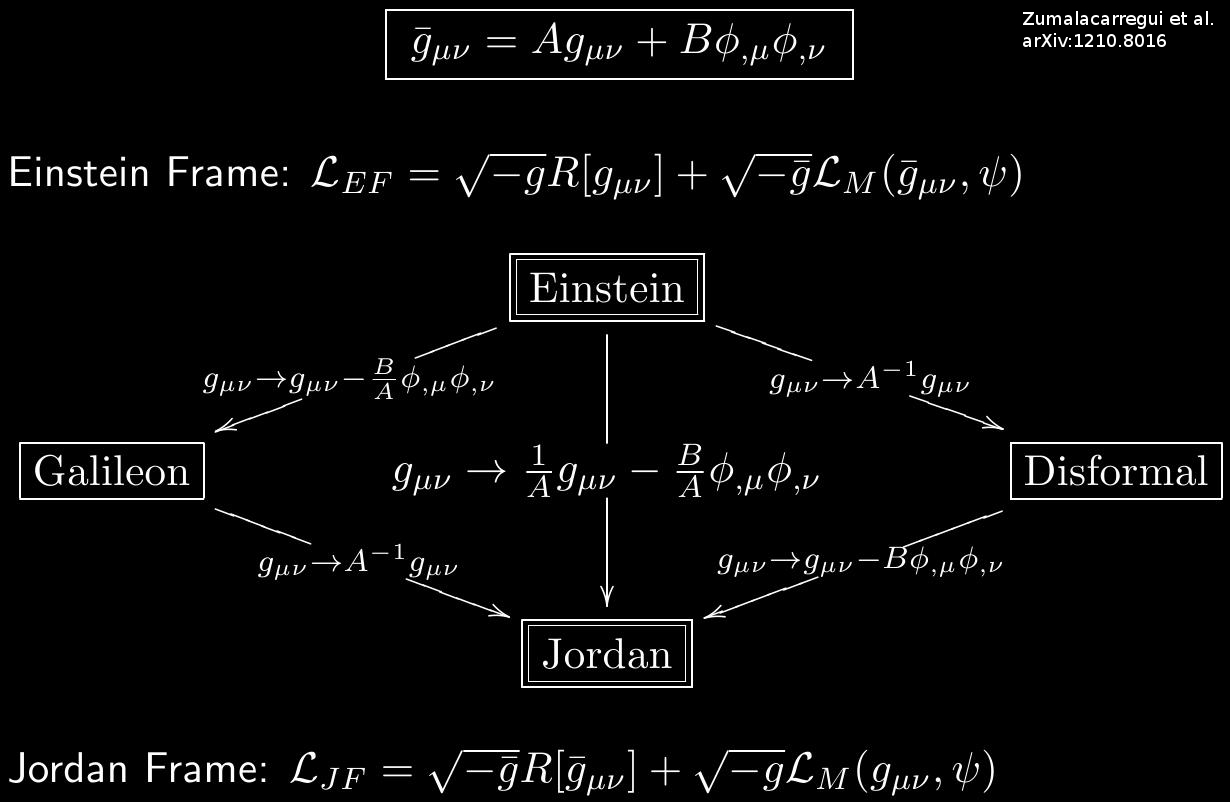
- Screening modifications of gravity through disformally coupled fields Phys. Rev. Lett. 109, 241102 (2012)
- Field redefinitions in theories beyond Einstein gravity using the language of differential forms Phys. Rev. D 95, 084039 (2017)
- DBI Galileons in the Einstein frame: local gravity and cosmology Phys. Rev. D 87, 083010 (2013)
- Disformal scalar fields and the dark sector of the Universe JCAP 05, 038 (2010)
- Dark energy and tests of gravity, review talk at the EuCAPT Annual Symposium (2022)
- Solutions to the H0 problem beyond general relativity, talk at Cosmology from Home (2020)
- Beyond-Horndeski theories, talk at Extended Theories of Gravity, Nordita (2015)
Scientific coordination and future observatories
Present detectors are the beginning of gravitational-wave astronomy. Much of my community work goes into the observatories and surveys that will follow, and into making sure gravitational lensing has a place in them.
LISA
LISA is where wave-optics lensing stops being a curiosity. At millihertz frequencies the wavelengths are long enough that diffraction by dark-matter halos becomes detectable. Left unmodeled, it could also bias the inferred source parameters. Preparing the mission for that is part of the Cosmology Working Group's remit.
Euclid
Euclid maps both the galaxies that host gravitational-wave sources and the structures that lens them, which is what makes the connection worth building: the same survey supplies the redshifts for standard sirens and the lens catalogs for multi-messenger lensing.
- Euclid — I. Overview of the Euclid mission Astron. Astrophys. 697, A1 (2025)
GW-Space 2050
The scientific case for ESA's gravitational-wave missions after LISA. Decisions taken now about frequency band and sensitivity determine what is measurable decades from now, so the cosmography case has to be made before the instrument is designed rather than after. The μHz band is a particular opportunity: it reaches sources no other detector will see, and lensed events become more common the further out a detector can reach.
Future detectors and mission concepts
Next-generation ground detectors will see far enough that lensed events stop being rare, which changes what a lensing search has to be able to do. GUEST is a separate concept altogether, detecting gravitational waves by tracking satellites.
- GUEST: Gravitational Universe Exploration with Satellite Tracking arXiv:2607.18390
- The next generation global gravitational wave observatory: the science book arXiv:2111.06990